Friday, September 11, 2026

Rosh Hashannah: Structure and Form

On Love and Marriage: Rosh HaShanah as a Reminder 

                                                 Alejandro Glatt; 2026

As we enter the Yamim Noraim (Days of Awe) we are called on to recollect powerful moments in our people’s history. The תפילות (tefilot - liturgy) of the High Holy Days are meant to provide us with the fuel to consider these moments in the context of our lives. Specifically, during the Rosh HaShanah Musaf Amidah (the standing prayer), we evoke three powerful themes: מלכויות, זכרונות, שופרות. Malkuyot – verses dealing with God’s sovereignty (God as King), Zichronot – verses pertaining to God remembering, and of course Shofrot – verses in which a shofar or shofar blasts are mentioned.

Gustav Dore 1877

Many of the scenes that are recalled in this central prayer are like the “greatest hits” of the Torah. Among the list of moments, God remembering Noach in the ark, God remembering the brit (covenant) after hearing Bnai Yisrael’s wails in Egypt, and of course –  מעמד הר סיני – standing at Sinai. At Sinai, the Torah recalls Bnai Yisrael hearing the thunderous blasts of the shofar, which parallels our experience of hearing the shofar (at least) 100 times over the course of Rosh HaShanah. Each time the shofar blasts we recognize that we stand at the ready just as our ancestors did thousands of years ago. 


                                       Le Shofar; Marc Chagall 1914

The previous chief rabbi of England, Lord Rabbi Jonathan Sacks, of blessed memory, wrote extensively on the epic scene of Har Sinai, and Bnai Yisrael’s response: נעשה ונשמע – “We will do and we will listen.” According to Rabbi Sacks, Bnai Yisrael’s responding first by acknowledging that they will perform the mitzvot, and would only later hear or understand them, makes total sense. Rabbi Sacks explains that this bond, between God and the Jewish people, is like a marriage. One only truly understands marriage and the commitments therein once married (“The only way to understand leadership is to lead. The only way to understand marriage is to get married.”). 

We understand roles by living them, and we understand a life informed by and guided by Torah only by living it. Sacks’ explanation meshes beautifully with John Dewey’s (the godfather of progressive education) characterization of learning: “Education is not preparation for life, it is life itself.” 

Wishing us all a fruitful year שנה פוריה, filled with the fruit of the hard work, determination, and commitment that we will put in.


Wednesday, April 8, 2026

Making AI Work for Me: GenAI in the Educational Workspace

Two ways to use AI as an Education Administrator


There’s a lot of hype about AI, and for good reason. In this article I lay out two use cases for Generative AI that have changed the way I work. For context, I serve as head of a team of more than a dozen educators and am privileged to help them plan their units of study, it’s a process of curriculum design. Secondarily and simultaneously a not insignificant piece of the job involves collecting and analyzing student data, with the intended goal of being able to eventually review the outcomes of student learning to glean lessons for next steps, as well as judge the general health and well being of the program. All of these tasks are being made exponentially more efficient with the use of generative AI, coupled with careful prompting and planning. 

Take for example the lesson planning process. Once upon a time teachers sat down with a template. This hand written document then informed their carefully typed or hand written worksheets, designed to guide the learner. We’ve developed since then and today we use Word or Google Docs, plotting out the curriculum page by page. Today, many teachers use PowerPoint and Canva to create engaging slideshows that partially replaced the black on white learner materials. This process is fundamental to the planning and eventual implementation of the materials for an engaging lesson. It’s also terribly time consuming and repetitive. The perfect field for generative AI. 

Whether you use Google (Gemini and Nano-Banana) or OpenAI (with ChatGPT) the work of finding an image on Google Search, laying out the image next to a description thereof, and imagining how things might be before hitting the blank page saves time. Want an image? Request a 4x4 grid of high quality cartoon style images that are arranged by the topics you’ve already agreed on. It’s a step change in how much can be produced, and how easily the data can be interpreted. When prompted properly, and fed the data, AI can be a partner to school administrators by making the production process painless and the data analysis lift lighter. 


Here’s a use case: three times a year we assess the student reading using an assessment tool. In short, it tells us how much a student reads (in total correct words read in a minute) and how quickly (in terms of correctly read words per minute). The data is collected three times, and the median number is used for data analysis. These data points are then compared with standards / expected outcomes in 2nd—4th Grades. Proctoring this assessment is an intense workload, with teachers devoting time in order to hear each student read to them. It’s a logistical investment and valuable time is spent ensuring that each student is being “pulled” for a 1-1 check-in, reading in defined intervals (one minute on the clock using grade appropriate texts). That’s before the the data is manually inputted to a LMS (learning management system) which then produces, upon request, a variety of graphs and tables. Next comes the crucially important, heavy administrative lift: Combing through all the data. 


Good data analysis requires a good eye and team work, taking care to notice trends in grade bands, comparing results from one class to the next, year-to-year and longitudinally, and the while trying to make the best informed decision on what to do next in the cycle of assessment that leads to informed instructional choices. 


The hard part, until now, for me at least, was making sense of all the data. Here are the results of several hundred students. Where to begin? How can we make the assessment work for us after all the effort involved in making the assessment happen in the first place?So I fed the PDF’ed versions of all the class graphs and charts into my personal favorite AI, Gemini Pro, and told it to go to work. What it was able to do for me, I don’t think I could have done for myself in 5 hours, and that was my Aha moment. Any school admin that isn’t using AI is missing out on a powerful partner, great at sifting through piles of data and producing rough drafts of what to do with it. I asked Gemini to review the data, and propose: how to divide the students into three instructional groups by ability and then propose a series of activities appropriate for each newly formed group over the course of a week. Once we agreed on the first two steps, we even designed those activities, creating high quality visually appealing educationally and developmentally appropriate materials for instruction that support the plan, minute by minute. That’s powerful partnership that is available at the click of a button.

Other than the cold dry numbers of assessments, Generative AI can make you, yes, you, the designer of any range of educational material. Who used to design infographics on ancient times? Textbook designers. What if the book hadn’t been written? Or, as in the case of Modern Hebrew, won’t be written by a major publisher as explained to my colleague in the field, since the demand just isn’t there from a numbers (total student base) perspective. Spanish — check. Plenty of materials. Math for 4th Grade — dozens of textbooks, teachers guides, workbooks and standardized additional resources, think accompanying PowerPoints. 

For language teachers, and specifically Hebrew language teachers, the list is much shorter. Take for example the offerings of CET, the Center for Educational Technologies. Perhaps the best producer of Hebrew language workbooks developed for elementary students. The vast majority of their offerings are designed for an Israeli audience, and not English speakers learning Hebrew in America. Until this year they hadn’t released a single program for American students in the early elementary grades. Zero. And even now, that program is hundreds of dollars per class, and involves a handing over of not only significant funds, but also power in what will be taught and how. The song the publisher picked gets played, analyzed and sung, the one your team would like teach is the price. 


Enter AI. Point in case: The fourth grade team

is in a mode of constant development. The work flow often revolves around reviewing and refreshing the extant curricular resources (many of which were developed through grants dozens of years ago) such as Chaverim B’Ivrit (Friends in Hebrew) program which is still in wide use despite its age and limited language production and minimal further development and updating. The teachers work their magic, thinking of what they wish they had — visual representations to help their students make sense of the language. It used to be a painful

process of scouring the internet for images, low quality clip art and Word graphics. Not anymore. Here’s what we did instead: We employed the brains and brawn of Google Gemini in the design of the unit from soup to nuts. 


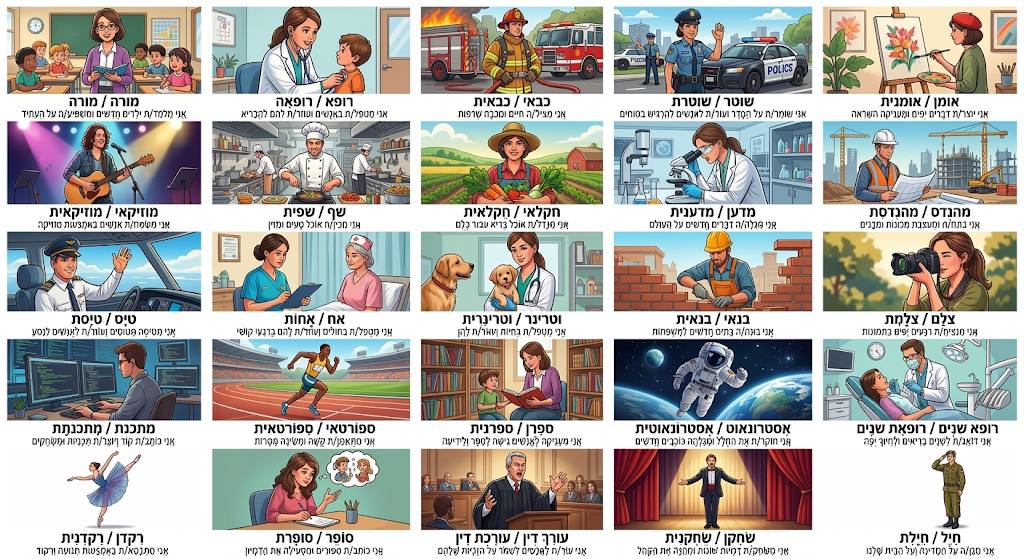
We use Gemini’s chat bot to explicate the lesson’s many facets. Step one: Tell it what you’re doing. In my case, I describe the task as designing a new unit of study that centered on the topic of different careers, בעלי מקצועות . The inspiration for the mini unit, was the desire to help students describe their world — the adults in it (parents and trusted adults) as well as their own hopes and dreams. Desired outcome: Help students learn to say what they want to be when they grow up, while teaching them about jobs, actions and descriptions. Gemini understood. With gentle prompting, a cascade of Hebrew gushed forward: lists of jobs, descriptions of their roles, comprehension activities based on those newly generated texts, and importantly: all aligned to ACTFL (American Council on the Teaching of Foreign Languages) standards. The work product was clean, met the goals, it’s theirs, and it looks great. I mean professional grade, flawlessly aligned visually and pedagogically and it took: thirty seconds. Here’s a cool trick: Once you’ve done all that work; the fun has just begun. Type: “Make another”. Type: “Review for errors and make it better.” Run that a few times. What is produced at the end of this creative process is the combined humanpower of ingenuity married with the machine power of data crunching. 

One more example (below). With credit to the Leittner group in Israel, and the Negba organization, here is a language sheet designed for Israelis, native language learners. With a few prompts and permission, the black on white sentences became visually aided, appealing and rich. These sentences can then be manipulated into different language tasks by printing out the illustrations. Matching the text to the illustration, describing the illustrations (with and without a word bank), telling the story the picture has to tell — these are child friendly and grade / language appropriate tasks for all early childhood learners and language learners more generally. 


Above: Reprinted with permission, a language task worksheet involving cause and effect, using connecting phraseology — so / therefor / as a result… to encourage production of longer more complex sentences, developed in Israel. 

 Below: A series of images I created with Google’s Nano Banana 2, for use in a Hebrew as a second language classroom. Same sentences, visually aided, created in a
matter of minutes 


. 

Want to discuss? Reach out to me directly at mickfine@gmail.com

Enjoy the article? Share online and let me know.

Thanks for reading,

-Mick


Rabbi Mick Fine

Director of Lower School Hebrew and Judaic Studies

The Leffell School; White Plains, New York

Sunday, November 24, 2024

5 Practical Takeaways from ACTFL 2024

This weekend hundreds of the world’s best and brightest language educators gathered in Philadelphia. With more than 40 options per hour, and topics ranging from integrating graphic novels to AI language labs, we engaged in discussions, presentations and roundtables about the art and craft of language teaching. 


This was my first opportunity to attend ACTFL, the American Council on the Teaching of Foreign Languages, conference with thanks to the administration of The Leffell School, who value professional development at all levels, and invest in raising the bar of Hebrew education at our school. 


Here are 5 practical insights gleaned from the sessions I attended. None are Hebrew specific, and using any of these methodologies will necessarily be a process of experimentation and reflection to make it your own.   


  1. “Surveys” — Print out the names of the students in the class on cards. On a flat surface post a question with three options. Students place their name card next to their answer. Example from ACTFL presenter Paz-Soldan — my family is big, small, medium. One can easily imagine the range of possible questions - favorite sport, ice cream flavor, holiday… this is a great low tech and low prep activity that is both community building and a way to bring students into the target language upon entering the room. Recapping or summarizing the results of the survey is an opportunity to use language in a real context. 
  2. “Calendar talks”. An opportunity for students to share major events in their lives this month. The students practice using the names of the month in the target language numbers, and learn how to share relevant data. Children, especially young children, love birthdays, sharing when a grandparent is coming, or talking about an upcoming vacation. The teacher models describing the events and in retrospect is able to follow up on major events, games, and celebrations. This is community building and language education.
  3. “Story asking” — Through this methodology within five minutes all the participants were able to retail a story in Russian. TPRS (Teaching Proficiency through Reading and Storytelling) has been in vogue for many years. This adaptation, of structuring input in the form of questions, helps students follow the extremely patterned and consistently structured story, always consisting of one character, one goal, one problem, three locations, and a happy ending. How many of our intermediate students are able to verbally retell a story of similar length? With frequency and practice one could imagine truly complex stories and grammatical forms, all delivered in a low anxiety format, somewhat reminiscent of an improv sketch. 
  4. Categorization involving matching / identifying — before students produce paragraph link texts they can associate those building blocks to various subheadings. Imagine for instance, students in the intermediate, low level, reading sentences and physically placing them under the category winter spring, summer fall, things that are done at the mall versus at home, or at a lower level items found at home vs. school. Before students are able to compose beautiful and complex sentences, they can create interesting and relevant lists. Associating sentences with subheadings is a similar task. They don’t need to create, they only need to identify the gist. 
  5. Make writing purposeful again. If students are writing a journal about what they did on the weekend someone other than the teacher should read it and respond to it. For in asking which mall they went to if they mentioned going to a mall or asking if they are good at skiing if they mention skiing. 


The net effect of implementing these elements into your classroom is more comprehensible, relevant, and interesting language comprehension and production. 


Thank you for reading, and good luck!


Respectfully,


Rabbi Mick Fine

Director of Hebrew and Judaic Studies

The Leffell School


Wednesday, February 13, 2019

Teaching Hebrew Culture with a Critical Lens

When we teach a song, storybook, or movie there are implicit messages being shared. These texts come from people that have been raised in a real, and therefore - complicated culture. These figures, and their cultural products are not simple. Instead we are confronted with cultural icons that are complicated, and models that are not wholly positive.

The Cultural Iceberg - what you see and hear
explicitly, and understand implicitly.
Static and Ben El Tabori in "Silsulim" describe life in Israel -
"...alcohol from Russia, Moroccan food, an Ashkenazi violin..."


Complicating this issue is that most Hebrew language students are not adults learning in an Ulpan (intensive week long seminars) setting, but rather primary and secondary age students that are forming their understanding of the world from their own experiences. As educators we design those experiences, which are like encounters with a foreign land. 


As we engender love for Israel through Hebrew, we also bring with that love a familiarity with the land, it's people, and the products of its people -- their culture which we love, appreciate, and consider our own.

So let's see - we are bound to teach the language, there are many "problematic" texts, and students are of young age. What can be done?

I'd like to argue that this is a wonderful opportunity for real relationship with Hebrew and Israel through Hebrew culture. Discussing with students the truths presented to them in texts, and their understanding of those truths can inform and deepen their relationship with the producers (Israel), and the culture that produced it (Hebrew).  Additionally, meeting students (even young ones) at their level cognitively in a foreign language sends the message that you'll need your whole self for this job.

Let's take two examples - one a song, and the other an illustrated storybook. חגיגה בישראל by Lior Narkis and Dudu Aharon is a relatively new (2017), and popular (9.8mil views) song that expresses a clear love for Israel - it's our בית (bayit - home) for which we should "תגיד תודה לאל" (taggid todah la'El - say: thank God!). The song also communicates that the land is beautiful, skies clear,  and filled with "the most beautiful women". Also - the men are "so suntan that they are all the color of chocolate" - ״כולם צבע שוקו - וואלה איזה שזופים״.

Clearly not an "appropriate text" if we were going to try to select a "pareve" (a yiddish term for things that are neither milk nor meat) product of Israeli culture. There's a clear focus on outward appearance, aesthetic beauty, and even falsity (some of us are faire skinned, or suntan infrequently / unsuccessfully).

But notice the power of the moment -- now we have something to talk about! It's no longer about "What does x mean?" which linguistically is difficult and bland, but rather "Is this true?" and "Why is this being said?" which drives learning to a significantly higher cognitive level. In education we can ask questions and build out assignments that require those upper levels of thinking. In Hebrew education similarly, tasks can be challenging because we are asking the students to use their minds.

In the case of the song with questionable lyrics -- we aren't asking students to solely remember the song or facts presented (low level), nor to simply understand those lyrics (slightly higher) -- we are asking them to analyze and evaluate those lyrics for truth, to consider their own worldview in light of what is being presented to them and to express an opinion - even simplistically. 

Similarly, the book הפיל שרצה להיות הכי shares the tale of an elephant that becomes colorful. He is consequently humiliated, sprayed with water "for being a joke", and decides to revert back to his old color, learning that grey is the color for elephants, full stop.
(credit to Meira Barna Goldberg for her thoughtful analysis and critique of this and other Hebrew children's storybooks)


As educators then we are presented with a choice: 

(a) We can take this seemingly childish story, expressing the value of uniformity and exhibiting bullying behavior and say: This is not appropriate - let's choose something else (some might say - "Anything else!"). Perhaps a sad story about a boy and his turtle (see below), or the classic מעשה בחמשה בלונים that delves deeply into the joy and sadness that balloons bring. Perhaps a new favorite about a happy lady that chooses her clothes based on the day of the week.

click here to hear the author read
click here for the animated version (10:50 mark)


(b) We could also take a different tact, and say "it's a modern classic" and bend to the canon. 

I'd like to argue that we'd would then be missing out on a real conversation about the value of difference, the harm that behaviors can cause, and how we all deeply do feel different. Teaching the value of difference, in Hebrew, through Hebrew culture, is a wonderfully rich way to speak about an ever relevant topic.

                                      
שווים (Equals) by Elai Botnar - discusses differences;
Here performed in sign language by Rishon Letzion

This is not to say that all texts must be controversial, or that every controversial text should be taught. Instead I am offering that in addition to the canonical books about balloons and turtles, we also offer our students intellectually challenging lenses through which to look at their texts, for which we'll need something worthy of our critique.


**Special thanks to R' Ayelet, Julia, and others for thinking through this complicated issue with me**

Monday, February 19, 2018

Habits of the Heart: Integrating Social Emotional Learning within Modern Hebrew Language Classes

Mick Fine
Director of Hebrew Language Curriculum and Instruction
Beit Rabban Day School; NYC

In every school, students interact with their classmates and develop as social beings. As teachers we plan for these interactions, we build activities, and watch our students develop those skills necessary for navigating their social circles. Since we know how crucial the ability to collaborate, and to resolve conflicts respectfully are, a question we need to ask is how might we effectively plan for social emotional learning, and what benefit might be found by doing so in a Second Language Acquisition (SLA) context? 

Integration of content areas is a staple in the Jewish educational field. Practitioners of progressive Jewish education are accustomed to thinking about innovative ways to blend learning of say the arts with Judaics, music with history, geography with cultural studies.

Social emotional development is a hallmark of early childhood, continues throughout the early elementary years into young adulthood, and even beyond. Just as people grow physically there is growth in terms of the ways that people understand themselves and their emotions, as well as those with whom they have meaningful relationships - their friends, family, classmates, and educators. 

Taking on the challenge of developing and powerfully implementing a Hebrew language curriculum that specifically addresses some of the most frequent challenges that students face — their emerging understanding of how to navigate interpersonal relationships and express themselves — is no small task. Each "subject" on it's own has associated methodologies, philosophies, and approaches. Why blend them? Beyond the well-researched and documented benefits that learning a second language provides, spending instructional time in a Hebrew class sends an implicit message -- that this is important enough that we attend to this issue with a variety of educators, in a variety of settings.

Why Hebrew? Well, for one it’s a language, and communication — and the skills involved in understanding another and expressing oneself are crucial in forming, nurturing, and strengthening relationships. Building proficiency necessitates interaction, the one is the result of the other. 

At Beit Rabban Day School we plan activities that demand of students a high volume of interactions through the use of surveys (picture 20 students asking one another What’s your favorite season? Did you eat a sufganiya last night?), and we explicitly discuss, define, and practice respectful interactions. Students learn about each other and how to express themselves through debates, group journal sharing, and interviewing, coupled with examination of “authentic” Israeli cultural products such as videos, poems, and songs that discuss experiences of fear, sadness, loneliness, silliness, and friendship. The students learn to use the vocabulary to describe the characters emotions and the social challenges that the characters experience in the “texts”. 

In one such class, students “read” a comic, by modern illustrator Yossi Abulafia that has only two words, the name of the comic: לבדי בבית — Home Alone. 


The seven and eight year old students, learning in relatively homogenous groups, are tasked with describing the action scene by scene, square by square. The open/closed nature of the prompt provides the students an opportunity to use the language they do have to tell the story of a child, his choices, what he’s thinking and feeling. Over the course of thirteen linked “moments” - students describe wanting what he doesn’t have (ice cream), noticing he was alone, and playing by himself (and his cat). The students tell the story in 1st person, casting themselves as the main character and sharing the thought process inherent in the choices. 

In another class a small group of “heritage learners” (advanced students with Hebrew speaking homes or particularly high aptitude) are tackling how one conducts oneself during a debate. As pairs of students face off, delivering pros and cons  — they are called upon to respond thoughtfully with prepared comments, to rebut their classmates in increasingly sophisticated ways. Given potential sentence starters such as 
אני מבין אותך, אבל בכל זאת... I understand you, but despite that... כן, אבל מצד שני — yes, but on the other hand... the students practice acknowledging the other and responding in carefully crafted and respectful ways while working on their articulation and fluency, strengthening their vocabulary, and developing their capacity to connect with others. 

As we continue to develop the emergent curriculum we respond to the challenges faced by the groups, for instance: an issue of cliques, of normal childhood fears (spiders? the dark?), and how there might be a מלכת השכונה — Queen of the Neighborhood; a בריון — Bully; or a מלך הכיתה — King of the Class. Each of the aforementioned is the name of a modern Israeli cultural element: an episode in an Israeli children’s series, a fun kids music album by famous Israeli (parent) musicians, or a modern Israeli poet.


Through the exposure to and discussion around the material, we uncover and discuss the emotions, concerns, and personalities of the characters, and present to students the language with which they can describe their own emotions, concerns, desires, preferences and experiences. Learning to use the language in these ways brings students to proficiency — ability to perform tasks in real settings.


Please write to mickfine@gmail.com for any associated files, lyrics (with vowels). Happy to help!


Tuesday, April 23, 2013

Peace is Great - Sharing a Poem - It's Poetry Month


This week's word of the week is שיר - shir. It can mean song, or poem.  שירה (shira) can mean a song or poetry. Since it's Poetry Month I thought it would be nice to share with you a poem that I came across in the last few weeks, that I've come to really love.


The poem is by Yehuda Amichai, an Israeli poet that lived through too many wars - you can see it in his writing.

The poem was written in Hebrew (which I've posted at the bottom of the page).

Enjoy!


Wildpeace
 - Yehuda Amichai. Translation by Chana Bloch

Not the peace of a cease-fire,
 not even the vision of the wolf and the lamb,

but rather
 as in the heart when the excitement is over
 and you can talk only about a great weariness.

I know that I know how to kill, 
that makes me an adult.

And my son plays with a toy gun that knows
 how to open and close its eyes and say Mama.

A peace 
without the big noise of beating swords into ploughshares,
 without words,
without 
the thud of the heavy rubber stamp: let it be
 light, floating, like lazy white foam.

A little rest for the wounds –
Who speaks of healing? 
(And the howl of the orphans is passed from one generation 
to the next, as in a relay race:
 the baton never falls.)
Let it come 
like wildflowers,
 suddenly, because the field
 must have it: wildpeace.


It seems that the poet is pointing to some time in the future when people, perhaps of the whole world - "the field" -  demand peace.

In the Jewish religion the concept of peace is in many ways central - the Talmud states that "peace is great" - גדול השלום - so great in fact, that we end our prayers only with peace - עושה שלום - Oseh Shalom (maker of peace) , or שלום רב - Shalom Rav (great peace). 


Over the past few months I've been working with an Israeli student on his Bar Mitzvah.
We've been reading the prophet Isaiah, in preparation for his Bar Mitzvah in Israel. We've read and discussed Isaiah's vision of peace, redemption, and return to Israel.

I think it's fair to say we are both inspired and depressed by the words - it seems like on the one hand it's come to fruition - we have (in part) returned to the land (well, parts thereof at least), and yet, the element we need to enjoy it - peace, is so distant. I wonder if it's even possible. And so, we are left with this sense of longing despite the existence of The State.


So what's going on with those prophecies?

I learned a beautiful teaching this morning:


"The prophet predicts only that which should be."

(Tosafot on Talmud Yevamot 50a)


I'd love to hear your thoughts... please comment below, and share if you feel comfortable.


Below you will find a source sheet I wrote on peace in the Jewish Bible - the Torah. If you're interested in teaching it / using it, just right click and save the image, and print - if you use it, let me know how it goes. Mickfine@gmail.com

Also some full curriculum / lesson plans using poetry to teach Jewish History below, scroll to the bottom.


Sharing some resources for educators...


Wednesday, April 17, 2013

What on Earth is Holy? My Senior Sermon

The word of the week is Kedusha - קדושה - Holiness. This is a transcript of my senior sermon, delivered 3:30 April 17th, 2013:


My Family, my friends, my loved ones, my teachers, my rabbis, my classmates - I stand before you today to share my senior sermon, and it's the last senior sermon of my class – it’s a class I'm honored to be graduating with. Over the past several months we've heard from these remarkable people about chova, mitzvah, v’hachana– obligation, commandedness, and the preparation that we've lived for the past 4, 5 or even 6 years.

And thisweek we come to the point in the reading that sheds light on some of the biggest questions we as humans can ask:
What is our purpose on this planet?
What does God require of us?
How do we live a meaningful life inthis troubled world? and
How do we spend that limited amount of time we have walkingthis earth when life is so fleeting – when, as we saw earlier this week, tomorrow is promised to no one. 

Baruch Ata Adonai Eloheinu Melekh Ha’olam Asher Kidshanu b’mitzvotav v’tzivanu Laasok b’ivrei Torah
We thank you God, ruler of all, for the opportunity and honor to spend time engaging the words of Torah. 

We read this week:


א וַיְדַבֵּר יְהוָה, אֶל-מֹשֶׁה לֵּאמֹר.  דַּבֵּר אֶל-כָּל-עֲדַת בְּנֵי-יִשְׂרָאֵל, וְאָמַרְתָּ אֲלֵהֶם--קְדֹשִׁים תִּהְיוּ:  כִּי קָדוֹשׁ, אֲנִי יְהוָה אֱלֹהֵיכֶם.

God spoke to Moshe, and said: Speak to the entire community of the children of Israel, andtell them: Kedoshim Tehiyu - be holy people. For I Hashem your God, am holy. 

This is on the one hand, a very concise commandment - a very few words “Kedoshim Tehiyu” – Be Holy. And even a rationale – Ki Kadosh Ani Hashem Elokeihem – Because I Hashem your God am holy.

On the other hand, the reader, we are left wondering:
What on earth is it to be holy?
And how on earth can I possibly be like God?! We are supposed tobe Kedoshim, like God is Kadosh – how do we make that happen??

I actuallyhave a long standing relationship with this text - when I came to my rabbinicalschool interview roughly 5 years ago, I spoke in a room down the hall, with some of the people that are in this room today, about how I understood this enigmatic phrase.

And then, onmy first day of orientation, the assistant dean; Rabbi Gelber, handed each person in the class a different slip of paper, each with a quote on it, the one handed to me was this verse. We were told to use our quote as a frame for our journey.

And today, we are all here together - looking at it, engaging it.

I'd like to tell you how I conceived of it then, and how I conceive of it now and whatchallenges I saw this text putting before us, and how I now see so much rolled into this efficiently phrased imperative. 

I rememberin that interview that I spoke about way the Torah continues. For me, it’s helpful to think about the phrase not as a standalone – you can’t make sense of this phrase in isolation, but if you look at in the context of what follows, and even what comes before, what emerges for me is that this phrase is somewhat the umbrella statement, the ultimate goal, and what follows, is the methodology- the details of how to accomplish this lofty goal: and so, in my interview I jumped– and started talking about how the Torah, a just a few sentences later continues:
Lo Tikallel Heresh, v’lifnei Iver Lo’titayn michshol –
We are commanded not to curse the deaf, and to not put stumbling blocks before the blind.

I explained five years ago that I was proud that our religion had this statement. I saidthat I was proud that our tradition, through the midrash – specifically Midrash Hagadol, and through later commentaries, flips this negative – the Torah reads: don’t put the stumbling block before them - into a positive: you must remove them. It's kind oflike: If you see something, say something. But it's more - it's something like:if there's a problem you're aware of, deal with it. And Specifically, davka in the case that you must act in orderto prevent a situation when there is no danger to you – the danger here is to others. Professor Mittleman explained that the Torah was talking here about moral hazards. I talked about the great teacher of teachers, Nehama Leibovitz zichrona l’vracha, and how she understood that:

"The Torah teaches us thateven by sitting at home doing nothing, by complete passivity and divorcement from society, one cannot shake off responsibility for what is transpiring in the world at large, for the iniquity, violence and evil there. By not protesting, "not marking the … danger spots, you have become responsible for any harm arising therefrom, and have violated the prohibition: "Thou shalt not put a stumbling block before the blind..."

I said that it was about speaking up when you see danger. I said it was the commandment todo good, to rectify injustice, and that we as Jews, we were sanctified kedoshim to do this mission – and that we don't have the permission to desist from this work – it’s our calling. 

This commandment is still one of the phrases in the Torah I most strongly connect with. When I see pictures of Rabbi Heschel on a civil rights march with the Doctor, Reverend Martin Luther King Jr. I can see in his face that he was acting in accordance with this mitzvah – he was living the words out – he was a teacher through his actions, a rav – by being an exemplar of the type of behavior he thought we should all engage in.

I’ve learned a lot in these last four plus years – I learned Torah, Talmud, Midrash, Codes of Law, Aramaic, Jewish History, how to console, how to lead, and even a bit about teaching. In our tradition we have a saying: “Mikol M’lamdei hiskalti" –from all of my teachers I have learned – "U’mitalmidai yoter mikulan"  -- though I learned the most from my students.

At the Heschel School where I have had the honor of serving as a rabbinic intern this year, I learned from the students the value of slowing down -  it’s often the case that we in these hallowed halls are called upon to read 100+ pages in English, or a half dozen pages in Hebrew, or even a few paragraphs in Aramaic (those amounts are all equal by the way).

Ma’aseh She’haya – one of my first days at Heschel, I had the opportunity to teach a class of 3rd Graders parshat hashavua (the weekly Torah portion) – I planned it out, I had the section of text that I planned on going through with them, and I began – I launched into the text of the Torah – within a minute a young man looked me dead in the eye, and gave me an enthusiastic thumbs up. "Wow", I thought, "I’m doing great!" As a teacher it’s rare that you get a thank you at the end of a lesson, let alone a thumbs up during the lesson. And as I continued, more students began giving me thumbs up – "Wow!",  I thought, "This must be the most successful lesson I’ve ever delivered – they are eating this up!" At about the five minute mark the teacher of the class, Yisraela, stopped me: "Rabbi Muki...", she said, "This [the thumbs up] means they have a question, they want you to stop – and go back, there’s an idea you’ve touched on they want to examine more closely." 

And as I stood there, surrounded by thumbs of inquiry, it dawned on me:

I learned that in my, and even our attempts to conquer the texts, we often undertake a kind of bulldozing in the process – we are so used to looking at these phrases, it becomes phraseology – that’s an introductory phrase, that’s a concluding phrase – what’s in the middle is the ikkar – the meat (or the tofu to you vegans out there).

And so when I sat down and really looked at this sentence – speak to the entire community of Israel, kedoshim tehiyu, I stopped there.

I stood in amazement as I focused on the beginning of the sentence, a part of the phase that I completely glanced over four years ago - speak to the *entire community* of Israel. I hear those words and I can't help but think there's something powerful and touching about the whole, that all, the entire community together is called upon.

It's not something rabbis do, or the inheritance or birthright of a special caste - it's the whole community's task and honor, goal and blessing: be holy. 

All of you. Don't say someone else will take care of the elderly, someone else will watch out for the disabled, someone else will show love ואהבת . It's on you. Not you alone. You will have allies. You have the whole community. 

Several years later – I know that community isn’t an abstract concept
–      it’s the end result of commitment,
–      it’s the outcome of like minded people striving to make it work –together.
–      And it takes a lot of work, which is why we call it community building
–      it’s about being in relationship with those people with whom webuild that community. Dabber El Kol Adat Bnei Yisrael – all the people. It can’t be accomplished individually, it takes a village.

And I stopped myself there. Wait – there’s more. Rewind – And God said to Moses. Why?What is the value of God instructing Moses to tell us to do this. Why are we commanded in the first place? Why did God choose to reveal the commandment? To quote Abraham Lincoln – “If you want to test a man’s character, give him power.” This, this, my friends, is the ultimate test, because we are given th eultimate power – be like God. Kedoshim tehiyu, Ki Kadosh ANI – Adonai Aloheichem. Be Holy, Because I Hashem your God is holy. It’s stunning how, when we peel back the layers of such a small small text, there is so much in it – הפוך בה והפוך בה דכלה בה.

And as I've been nearing graduation, and have had the time to sit on this phrase - la'asok bdivrei Torah - I've had a recurrent question pop into my head: we left Egypt, then we became a free people, and then we are commanded to craft a civilization– a kehillah kedosha – a holy community. My question is, and I hope we can all spend some time over the next few days pondering this: how did our experiences in Egypt – yitziyat mitzrayim - affect our conception of holiness – of kedusha? 

One way, is the focus that our religion puts on the least powerful, the least fortunate members of society. We learn that we must open our hands -פתח תפתח את ידך - to the poor, we learn how that is supposed to happen - various portions of our fields (we were once farmers) were portioned off for the poor, the stranger, the widow, the orphan – we give. 

The word that's used to describe that giving – the portioning - saying: this is for the poor, that amount in Hebrew is Mukdash. And that, I believe that what is meantby this root - kadosh. I'm going to set aside some part of my heart, my resources, and energy – לבבי  ,  נפשי  ,  מאדי for the betterment of the world. 

How do we do that 'marking' - we are not farmers. We can still open our hands and our hearts, we can use the rituals and the traditions we received – we can use prayers with family and community to spend our time on this earth bringing more kedusha– more holiness into a world desperately in need of it. 

And so, what does it mean when we are told to : Be holy people? 
It's the ultimate aspirational statement. 
And it the aspirational quality of this sentence: “Be Holy” that really contains the power.

And what is holy? In this sentence, we get the definition:
God.
Us.
Us, like God when we follow that model. As the tradition teaches:
Mah hu rachum – af ata rachum
Just as God is merciful – you too be merciful.
Mah hu ma’achil re’evim, u’malbish arumim – af ata he’echel re’evim v’halbish arumim.
Just as God feeds the hungry, and clothes the naked – you too should feed the hungry, and clothe the naked.

And as the great rabbi, the Sfat Emet – Yehudah Aryeh Leib Alter,  explained in his commentary on the phrase Kedoshim Tehiyu - it's only through minimizing oneself, and through putting the needs of the community first, and seeing oneself as part of the community and not separate from it, does one attain holiness. And as Rav Moshe Alshich said almost 500 years ago in his commentary on this same verse: the easiest thing in the world is to seclude yourself in your home, and be a holy hermit. What the Torah demands of us though, is to bepart and parcel of all the community of Israel AND be holy. 

I'd like to end with a prayer:
May we have the strength to achieve our goals and the wisdom to know they are lofty. May we be passionate in our thinking and action, and forgiving and compassionate of ourselves and others in that path, and May we thus merit to see a better world brought about through our convictions and our energies. V'nomar Amen

Want to teach this? Here are some curricular materials. Just right click, and save the image, then print - Enjoy!